Damascus, Feb. 3 (SANA) The full moon in February is traditionally known as the “Snow Moon,” a midwinter full moon named by Native American traditions and early farmers because of its association with peak snowfall during this time of year.
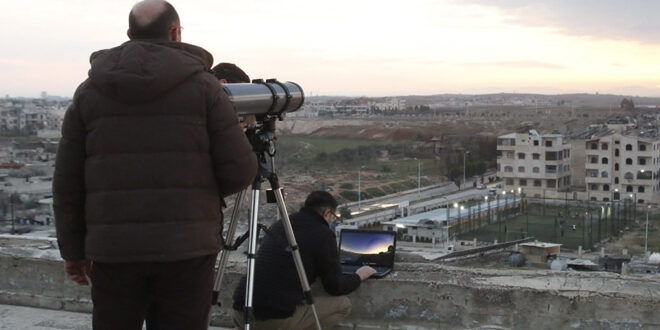
The event provided an opportunity for Syrian astronomy enthusiasts to gather in Damascus on Monday evening to observe February’s full moon, as part of a scientific activity aimed at promoting public awareness of astronomy.
The Syrian Astronomical Society organized the event to observe the rising of the Snow Moon at the Governorate Club in Damascus. Modern telescopes were set up to allow visitors to view the moon’s surface and motion directly. There were also explanations of basic astronomical observation techniques.

Muhammad al-Assiry, head of the Syrian Astronomical Society, said that observing the moon during its full phase, especially on the 15th night of Shaaban, is important for tracking lunar motion regularly and matching visual observations with astronomical calculations. This supports the accurate determination of the lunar month and preparations for sighting the crescent of Ramadan.
Al-Assiry added that this phase allows for clear viewing of lunar features, such as seas, craters and mountain ranges, many of which have Arabic names that reflect Muslim scholars’ historical contributions to astronomy.

Nabil al-Bish, a member of the advisory committee, noted that participants also observed Jupiter and its four main moons through the telescopes.
Association member Amani al-Sagheer highlighted the participation of children, stressing that hands-on observation helps develop scientific thinking and a spirit of exploration.

Khaled Qattaa, the cultural affairs officer at the Damascus Governorate Directorate, said that such activities play an important role in raising scientific and astronomical awareness among all segments of society, especially young people.
R.H